Blog
The ultimate resource for restoring hair using GHK-Cu peptide: a guide to copper peptides.
While anecdotal reports and small human studies correspond with its biochemical profile (there is a lack of large), placebo-controlled trials in dermatology. In animal models, the combination of these effects leads to quicker closure times and enhanced scar tissue. In cultures of fibroblasts (basic fibroblast growth factor (bFGF) secretion increased by about 230%), while procollagen type I C-peptide rose by 30% when treated with 1 µM GHK-Cu. The peptide specifically targets repair pathways without causing significant oxidative damage, unlike copper in its bulk mineral form. GHK-Cu (a small copper-binding peptide), signals the body to produce new collagen, accelerates wound healing, and can even stimulate hair follicles to resume their growth phase. This article does not promote any specific product (provider), or clinical approach.
But no published study has directly tested this on scalp skin or follicle inflammation specifically (so any benefit there is inferred from buy MOTS c online adjacent evidence), not demonstrated in a scalp trial. A 2017 study in Wound Repair and Regeneration found GHK-Cu-loaded liposomes accelerated scald wound healing in mice by increasing cell proliferation and angiogenesis. The existence of specialized copper-ion detection research shows that copper dosing and monitoring matter. Copper is an essential mineral the body tightly regulates, and people with Wilson’s disease or other copper metabolism disorders should talk to a physician before using any copper peptide product. That is a meaningfully different situation from “studied and found ineffective.” It’s “not yet tested directly,” which is its own kind of uncertain.
The 69-page research guide explains its evidence (provider-check and cost framework; the separate eight-page printable workbook gives you space to record your goal), unresolved questions, written costs and agreed follow-up. If this article raised a question about your health, our team can help you decide what kind of visit may fit. Based on the available research, here is a general timeline patients can expect.
A study of historical findings regarding the biological roles of GHK-Cu.
Getting clear answers from a trusted provider beats guessing based on marketing claims. Before committing to a new product or protocol — it helps to ask a few key questions. This includes reviewing bloodwork (discussing lifestyle factors), and setting realistic expectations about timelines and outcomes. Services like IV hydration and vitamin drips and body composition analysis can help identify gaps in overall health that may be showing up as hair thinning. Whole-body wellness also plays a bigger role than many people realize.
How is GHK-Cu studied in a lab setting?

As of 2026 it remains regulated primarily as a cosmetic ingredient, with no FDA-approved prescription formulation for any hair indication. Some studies report reduced shedding as early as 8 to 12 weeks, but full density changes generally require several months of continued use. You can also visit us on Google, InCare to read reviews from patients across Tampa and Riverview. Our patients often share their experiences on social media, where you can see real stories from people who have worked with our team.
Community reports sometimes describe GHK-Cu topicals as a lower-cost, daily-use complement to periodic PRP sessions. The most clinically relevant data comes from a 2016 study by Lee et al. evaluating a complex of 5-aminolevulinic acid (5-ALA) and GHK peptide in 45 patients with male pattern hair loss. A 2026 conference-proceedings report studied 18 adults using 2% GHK-Cu serum on one eyebrow and vehicle on the other for 12 weeks. Tian et al.’s nanoliposome approach (2022) achieved uniform particle sizes with high encapsulation efficiency. Whether topically applied copper peptides deliver enough copper to the follicular microenvironment to achieve this effect in practice remains an open question. This article examines the actual clinical and preclinical evidence behind copper peptides for hair loss.
“Modest effect in a laboratory setting” is not the same as the effect finasteride has, and treating them as comparable is the single biggest error in copper peptide marketing. The treatments with licences and randomised trials for pattern hair loss are minoxidil and finasteride — which are a conversation for a doctor. This article is educational and is not medical advice. Researchers think it carries copper to copper-dependent enzymes in tissues (possibly including the hair follicle), the small organ in your skin that grows each strand. A factual, week-by-week look at GHK-Cu , copper tripeptide, for skin and hair, based on published studies — not promises. Hair-focused cosmetic serums commonly use GHK-Cu in the range of roughly 1-2%, though products vary from about 0.05% upward.
Cell Culture Findings: Dermal Papilla Cells
According to a review, GHK is capable of regulating at least 4,000 human genes both upwards and downwards. In 86 patients with venous stasis ulcers — a 0.4% tripeptide copper complex cream was no different from vehicle . It compiles the product label (the method of delivery), identifies evidence gaps, and organizes your questions and observations all in one location.
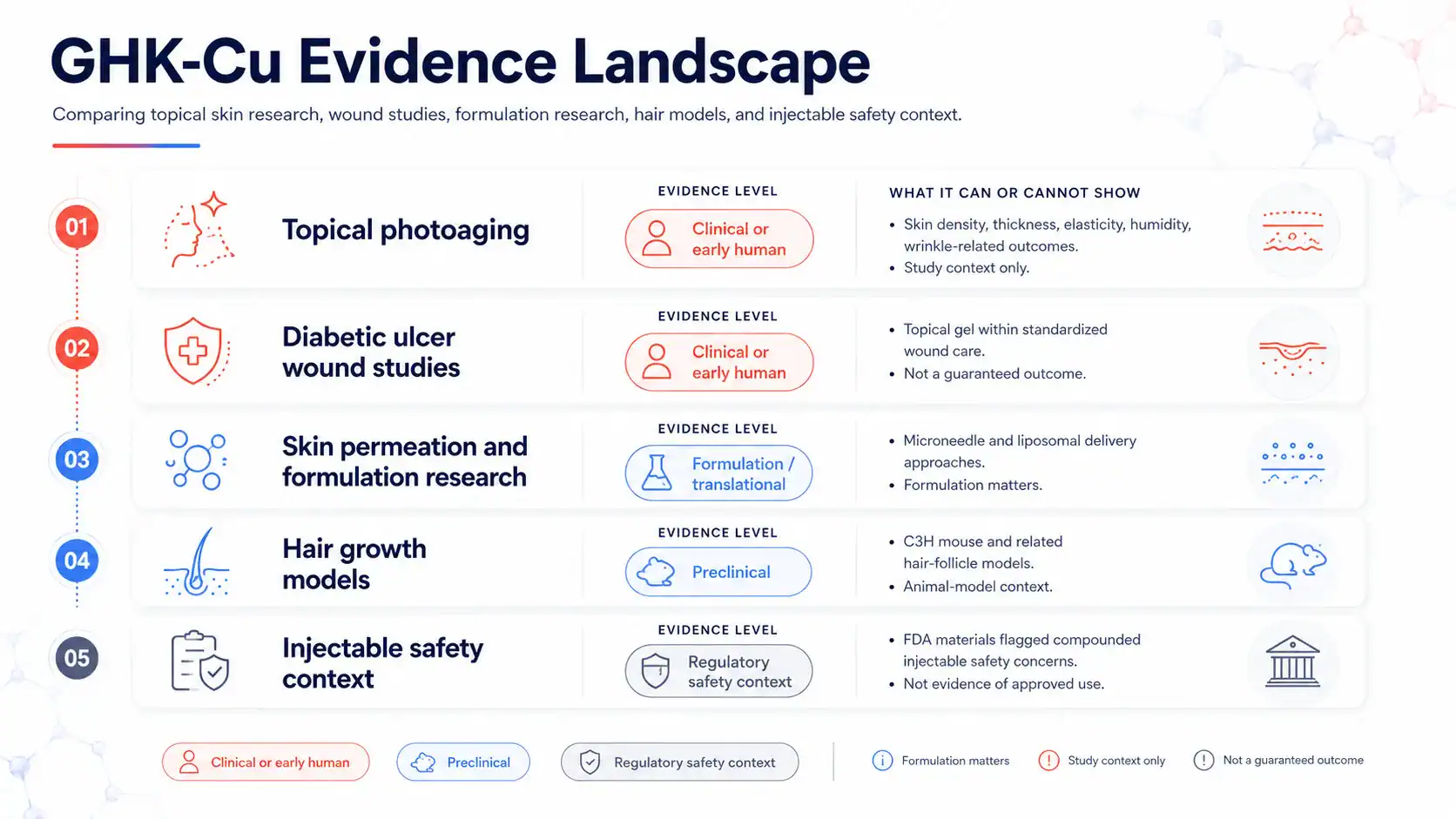
Interpretation of such studies depends heavily on controls — and single-arm reports provide weak evidence of synergy. Because these agents operate through different receptor and enzymatic routes, investigators sometimes examine them in combination to test whether effects are additive or redundant. Reported endpoints in cosmetic-science literature are summarised in the cosmetic benefits overview, and sourcing expectations for either category are detailed in the cosmetic buying guide for researchers. These distinctions are explored in the comparison of topical formulations and isolated GHK-Cu and in the article on cosmetic bioavailability and absorption efficacy. Facial-follicle model work is summarised in the beard growth research article, and the analogue comparison is covered in GHK-Cu and AHK-Cu skin and hair research.
Recent Comments